Product Certification vs. CPC
What Amazon Really Wants (and How to Get It Fast)
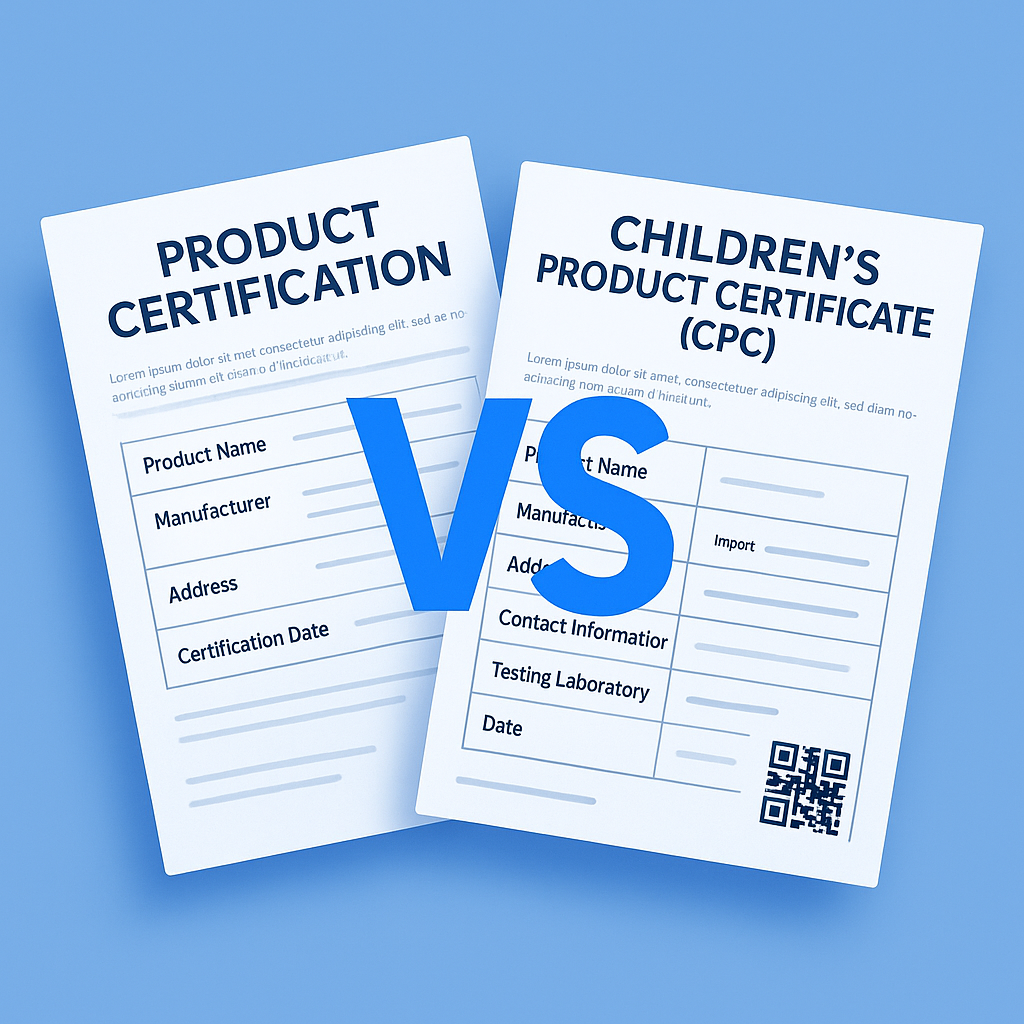
If you sell children's products in the U.S.—especially on Amazon—you'll bump into two similar-sounding ideas: product certification and the Children's Product Certificate (CPC). They're not interchangeable. One is a testing/certification service from a lab or certification body; the other is your legal certificate required under U.S. law for children's products.
This guide clears up the difference, shows how top China-based providers create the test report you need, and explains how DocAssure turns that report into a clean, compliant CPC in minutes.
Quick Summary (for busy Amazon sellers)
- Product certification = a service from a third-party (SGS, TÜV Rheinland, Intertek, etc.). You get testing, sometimes a mark, and a test report.
- CPC = your legal attestation for U.S. children's products, based on passing results from a CPSC-accepted lab.
- Amazon U.S. usually asks for the CPC for children's items (see Amazon CPC help).
- DocAssure turns your lab PDF report → CPC in minutes, starting at $4 per document.
What is a CPC (Children's Product Certificate)?
A CPC is your attestation that a children's product complies with all applicable U.S. children's safety rules. It's required under CPSIA for children's products and is what Amazon typically asks for in the U.S. market. You issue the CPC based on passing results from a CPSC-accepted third-party laboratory. You don't file it with the government; you provide it to Amazon/retailers and keep it on hand for CPSC or Customs.
— Learn more: CPSC: Children's Product Certificate (What to include) • CPSC CPC FAQ
Bottom line: Product certification can be valuable, but CPC ≠ product certification. If you're listing children's items on Amazon, the CPC is the document they usually want.
What is "Product Certification"?
"Product certification" (often phrased as product compliance certificate, product quality certification, quality certificate for product, or quality certificate of product) is a service from a third-party organization. They test your item against specific standards and, when it passes, may authorize a mark or issue certificates of compliance.
Common reasons to pursue product certification
- Retail/market access requirements (certain regions or retailers demand it)
- Consumer trust and conversion—visible marks can boost sales
- Assurance programs—ongoing quality checks, factory audits, or surveillance
Related terms you might hear
Certificate product, manufacturer's certificate of compliance, product certificate of compliance, tested certificate, test report certificate. These are often outputs of testing/certification workflows—but they're not a CPC.
CPC vs. Product Certification: side-by-side
| Topic | Product Certification | CPC (Children's Product Certificate) |
|---|---|---|
| What it is | Third-party service; testing & possible mark | Legal attestation from importer/manufacturer |
| Who issues it | Lab/certification body (e.g., SGS, TÜV, Intertek) | You (based on a CPSC-accepted lab report) |
| Purpose | Validate compliance; access markets; build trust | Show U.S. CPSIA/CPSC compliance for children's products |
| Primary document | Test report (and possibly a mark) | CPC PDF referencing test report(s) |
| Amazon use | Helpful background | Typically required for children's products |
| Where it's kept | With you and the certifying body | With you; provided to retailers/marketplaces; for CPSC/Customs upon request |
How product certification fits with a CPC (the simple flow)
- Product certification/testing → You commission tests against required standards (e.g., ASTM F963, CPSIA lead, phthalates, small parts).
- Test report issued → The lab provides a detailed report: product/SKU, methods, results, dates, and lab contact details.
-
CPC generated → You (the importer/manufacturer) issue a CPC based on that report, citing the exact rules and the testing lab.
— Official context: CPSC Testing & Certification overview
DocAssure sits at Step 3: it ingests your test report PDF from SGS/TÜV/Intertek/Bureau Veritas/CQC/CCIC affiliates and automatically drafts a CPSC-formatted CPC that retailers understand.
When you reach this step, generate your CPC here: Generate CPC
Top China-based testing & certification providers (quick takes)
These groups have large China footprints; for U.S. children’s products, always book a CPSC-accepted lab site for CPSIA/ASTM F963 work.
- SGS — Broad toy/CPSIA coverage with clear English reporting and bundled ASTM F963 + chemical testing, good when you need an all-in-one quote.
- TÜV Rheinland — Known for fast, standardized toy testing workflows and the recognizable TÜV mark; solid choice when you want predictable timelines.
- TÜV SÜD — Deep toy safety expertise and up-to-date F963 guidance, helpful if you need quick answers on what’s “in scope” before sampling.
- Intertek — Strong CPSIA practice with frequent updates on ASTM F963 changes—useful if your Amazon listing needs the latest clauses cited.
- Bureau Veritas (CPS) — Retail-oriented toy testing and inspection options that help small sellers reduce late-shipment risk.
- CQC — China’s authority on the mandatory CCC scheme and voluntary CQC marks; relevant if you also plan China sales or need local mark synergy.
- CCIC — State-linked inspection network useful for pre-shipment and trade-hub checks when you want an extra QA layer before export.
Pro tip: confirm the exact lab site is listed in the CPSC-accepted lab search before you test, so your CPC and Amazon docs align.
Tip: Ask your lab for an English test report and confirm the lab site address shown on the report—DocAssure pulls these details verbatim into your CPC. (You can verify lab acceptance here: CPSC Lab Search.)
How to work with Chinese labs for smooth CPCs
- Confirm acceptance — For U.S. children's products, use a CPSC-accepted lab site; verify the exact location that will run the tests.
- Specify the scope — Call out the precise standards (ASTM F963, CPSIA lead content, lead in paint, phthalates, small parts, sharp points/edges, cords, flammability as applicable).
- Align SKUs & samples — Ensure the report lists the exact model/SKU names you sell on Amazon.
- Request clean formatting — Ask for English reports with clear dates, addresses, and report numbers—that's what populates your CPC accurately.
- Update when things change — New materials, suppliers, or design tweaks? Re-test and regenerate your CPC to match the latest batch.
Pro move with DocAssure: Upload the updated report and generate a fresh CPC in minutes—no retyping.
CPC checklist: what Amazon and regulators expect to see
Make sure your CPC cleanly includes:
- Product identification: model/SKU, product name, age grading
- Applicable rules/standards: e.g., 16 CFR parts, CPSIA sections, ASTM F963 clauses
- Importer/manufacturer info: legal name, address, contact
- Testing lab details: CPSC-accepted lab name, full address, phone, contact person
- Test report references: report number(s), date(s) of testing, test location
- Manufacture dates & place: month/year range and city/country
- Responsible person: name, title, signature (digital ok) and date
- Conformity statement: a clear statement that the product complies with all listed rules
— Reference: CPSC: What a CPC must include • Amazon product compliance documentation
Common pitfalls that trigger Amazon rejections
- Wrong document: Uploading a lab quotation, factory CoC, or product certificate instead of a CPC
- Missing/incorrect citations: Listing "ASTM toys" instead of ASTM F963 or the relevant 16 CFR parts
- Mismatched SKUs: CPC lists "Model A," Amazon listing is "Model A-Blue (A1)"
- Non-accepted lab: Using a lab site that isn't CPSC-accepted for children's testing
- Incomplete addresses: Lab or company address missing country, postal code, or phone
- Out-of-date reports: New materials or design changes but still using last year's report
- Language/format issues: Non-English report with inconsistent date formats or unclear fields
— Helpful: Amazon CPC help
How DocAssure makes CPCs fast, accurate, and affordable
DocAssure is built for Amazon & Shopify sellers, importers, and manufacturers of children's products who need a CPSC-compliant CPC—without the headaches.
What DocAssure auto-fills from your lab PDF
- Product ID, simplified — We pull model/SKU, name, and age grade and let you tweak before export.
- Correct legal citations — Your test methods are mapped to the exact rules (e.g., ASTM F963, CPSIA, key 16 CFR parts).
- Verified lab details — CPSC-accepted lab name, full address, phone, and contact captured exactly as shown.
- Dates & traceability — Manufacture window, test dates/locations, and report numbers consolidated for clean audit trails.
- Signoff & export — Proper conformity statement, responsible signatory, and a polished PDF sized for Amazon uploads.
How DocAssure fits into your workflow
- Upload your lab PDF report from SGS/TÜV/Intertek/Bureau Veritas/CQC/CCIC affiliates.
- Review auto-extracted data: product/SKU, age grade, lab address, standards, report #, dates.
- Confirm or edit anything (e.g., manufacturer address, responsible person).
- Export a polished CPC PDF that's CPSC-formatted and Amazon-ready.
- Re-use the setup for variants or future batches—pay only per CPC you generate.
When you're ready to generate your CPC from a test report, head here:
Learn more: Generate CPC Sign up: Create Account
Why sellers choose DocAssure for CPCs
- Speed — Turn a lab PDF into a CPC in minutes, not hours.
- Accuracy — We extract and normalize the exact fields retailers and auditors look for.
- Compliance — Built around CPSC CPC requirements, including all mandatory elements for children's products.
- Price — Instant CPCs for as little as $4 per document—far less than consultants or lawyers.
- Focus — Built specifically for SMBs: Amazon & Shopify sellers, importers, and manufacturers.
Ready to Generate Your CPC?
If you have a lab report ready, convert it into a compliant CPC in minutes.
Generate CPC Now